
How to Market Your Rental Properties Purposefully | Landlord Profitability Play # 4
How you market your rental properties determines not just whether you fill vacancies, but the quality of tenants you attract and how much rent you can command.
Most landlords think of marketing as a basic to-do item: Take photos. Post the listing. Hope for inquiries.
But marketing isn’t neutral. It’s either working for you — attracting qualified prospects who pay well, stay longer, and respect the property —
or it’s quietly working against you, filling your time with dead-end leads and dragging your cash flow down month after month.
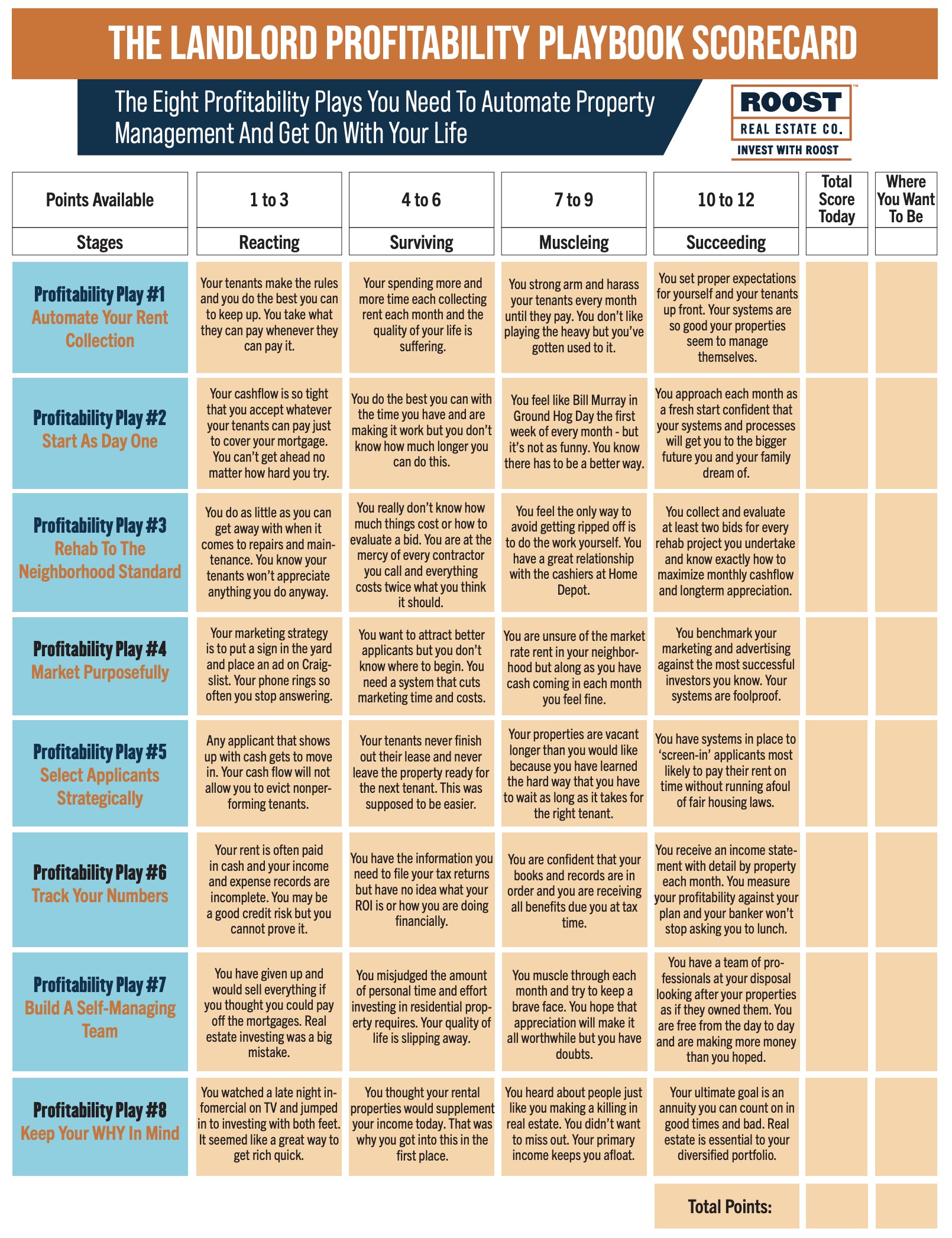
👉 Click here to download the Landlord Profitability Playbook Scorecard, and let’s walk through the four stages to see how purposeful your marketing strategy really is.
Stage 1: Reacting (1–3 Points)
If you’re mostly posting quick listings with lines like:
“3BR/2BA house for rent. $1,200/month. Call for details.”
— you’re operating reactively.
You’ll get inquiries, lots of inquiries. But most will be unqualified — people who don’t meet your income standards, aren’t the right fit, or haven’t even read the basics.
You’ll spend hours repeating details that should have been in the listing, showing the property to prospects who were never viable tenants in the first place.
This approach fills units, but often:
- Below market rent
- With higher turnover
- And more screening headaches
It works — but not profitably.
Stage 2: Surviving (4–6 Points)
Here, you’re trying harder — more platforms, better photos, more visibility — but still guessing.
You list everywhere you can think of:
• Zillow
• Apartments.com
• Facebook Marketplace
• Craigslist
• Local classifieds
Exposure goes up, but quality doesn’t.
You’re busier, not better. Evenings disappear into showings that lead nowhere. You know there’s a smarter way, you just haven’t built it yet.
This stage is common — and temporary — for landlords who are learning.
Stage 3: Muscling (7–9 Points)
This is where many small-portfolio landlords plateau. Your process functions. Vacancies get filled. But pricing is based on need, not data.
“I need $1,200 to break even — list at $1,250.”
Instead of: What does the market actually support?
Even a $100-$200/month gap adds up fast:
- $150 under market × 12 months = $1,800 lost per unit per year
- Over 5 units = $9,000 annual drag on cash flow
- Over 10 years? $90,000 left on the table
You’re working hard and filling units — just not maximizing them.
Stage 4: Succeeding (10–12 Points)
At this stage, marketing becomes predictable, measurable, and profitable.
You know your market:
✔ Average time-to-lease
✔ Real rental comps
✔ Where your best tenants come from
✔ How to position a property to command rent confidently
Your listings include:
📌 High-quality photos
📌 Detailed descriptions
📌 Income + qualification requirements
📌 Neighborhood context + benefits
📌 Professional, consistent branding
Only serious applicants inquire, and only qualified prospects schedule showings. You’ve built a system that works on purpose — not by accident.
And the result?
→ Shorter vacancies
→ Higher rent
→ Better tenant fit
→ Less stress and lost motion
This is where profitability scales — safely and sustainably.
Where Are You Today?
Watch the video now to see whether you’re Reacting, Surviving, Muscling, or Succeeding?
Think back to your last vacancy:
- Did you attract the right applicants?
- Did you fill the unit quickly?
- Are you confident you got full market rent?
If any answer was no, this Play is your next leverage point.
Marketing isn’t decoration — it’s direction. Done well, it pulls the right tenants toward you and keeps bad fits out of your inbox and out of your property.
CASH FLOW BEGINS WITH WHO YOU ATTRACT. And you don’t attract tenants — you attract the quality of tenants your marketing speaks to.
About the Landlord Profitability Playbook Video Series
In this video series, we’re going to walk through the eight profitability plays that separate successful real estate investors from those who are just surviving – or worse, failing.
So click here to grab the free scorecard, and follow along. This isn’t just another assessment tool – it’s your roadmap from wherever you are today to where you want to be 12 months from now.
Invest with Confidence—Invest with ROOST
At ROOST Real Estate Co., we know that profitability is the ultimate goal. That’s why we work so hard to ensure your properties are maintained to the neighborhood standard, marketed well, and rented to the right tenants.
PLUS… Whenever you’re ready, here are three ways we can help you automate your rent collection and get on with your life:
- Learn practical ways to free up your time and increase your profits. Listen to The Landlord Profitability Playbook Podcast at www.LandlordProfitabilityPlaybookPodcast.com
- Get a FREE Market Rate Rent Analysis for your properties. Sometimes a second opinion can make a big difference in your business. www.MarketRateRent.com
- Get a Personalized Property Management Quote and free property management consultation with Gretchen Mitchell at www.PMServicesQuote.com.

Chris McAllister
Chris McAllister was first licensed as a real estate broker in Ohio in 2003 and in Florida in 2015. He founded ROOST Real Estate Co. in early 2014.
Chris’s passion is creating and coaching business opportunities and strategies that support and add value to real estate professionals and their clients. He is the author of several books on the profession, including Protecting the Goose that Lays the Golden Eggs and Eight Success Habits of the New Real Estate Professional.
As both a real estate investor and landlord advocate, Chris also wrote What to Expect from Your Property Manager (Even if Your Property Manager is You) and The Landlord Profitability Playbook — a system for automating property management and reclaiming your time.
Chris is also the host of several podcasts, including Connect, Practice, Track, and Grow for real estate professionals, The Landlord Profitability Playbook Podcast for residential real estate investors, and The All Things Real Estate Podcast for home buyers and sellers.
Follow Chris on LinkedIn, YouTube, and Facebook for new episodes, insights, and landlord profitability strategies.